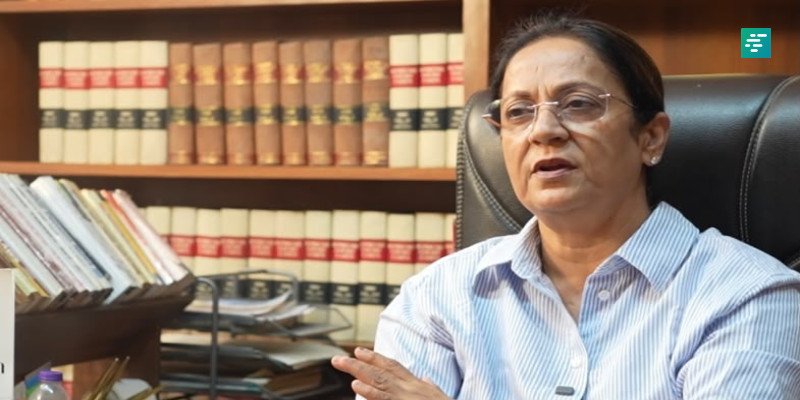
From Doubts to the Courtroom: Senior Advocate Nivedita Nirvikar’s Inspiring Journey in Law
- Campus Updates
- 16 Aug, 2026
- 360
For many young women, entering the legal profession can appear intimidating even today. For Nivedita Nirvikar, however, the decision to enter law was not born out of privilege or a ready-made professional legacy. It emerged from circumstances, determination and a strong belief that a woman could build a professional identity without abandoning her family or leaving Bihar. In a recent Betta Breakthrough podcast conversation, Nirvikar reflected on her journey into law, the challenges women continue to face in the profession, the importance of hard work and reputation, and why she believes young women should not be afraid of choosing law as a career.
Nirvikar comes from an agricultural family where education was strongly encouraged by her father. She recalled how her eldest sister was brought from the village to Patna so that she could study in a convent school; she later became a doctor. That experience, she explained, influenced the rest of the family, with her siblings going on to establish themselves in different professions. Her own journey, however, followed a considerably different route. She was married at around nineteen and had a family and children when she began thinking seriously about her professional future.
An MBA was one possibility, but it would have required her to leave Patna. Given her family circumstances, she began looking for a profession that would allow her to establish herself professionally while remaining in Bihar. Law eventually emerged as the answer. Admission itself was not straightforward. At the time, Patna University followed a points-based admission system, and because she had completed only a pass course, she had relatively few points. She personally approached the Principal of the law college and explained that she genuinely wanted to make law her profession. Her persistence eventually resulted in admission.
Her entry into the Bar was equally challenging. When she began practising, there were only a handful of women lawyers. Unlike several women who came from established legal families, Nirvikar entered the profession without a strong professional legal background. She recalled that even a senior who later became an important mentor initially discouraged her, suggesting that the profession might not be suitable for someone without a legal family background. Her response was simple but decisive: she had made up her mind to join the profession and wanted to know how to begin.
That determination became the foundation of her professional training. Her senior, Akhileshwar Prasad Singh, taught her the basics of legal practice, including how to present herself in court. He gave her a register and a pen and made her write lengthy drafts and petitions. On some Saturdays, she would prepare several petitions running into dozens of pages. Looking back, Nirvikar sees this demanding training as an important part of her professional development.
She also vividly remembers her first experience wearing the court gown. Initially, she felt shy and imagined that everyone was looking at her. Soon, she realised that the gown was simply part of the professional environment—everyone in the High Court was wearing the same attire. What once felt unfamiliar eventually became an inseparable part of her professional identity.
For Nirvikar, law is ultimately a profession that rewards commitment. She believes it can provide respect, financial rewards, recognition and social connections. But she also emphasises that success in law does not require everyone to possess exactly the same skills. One lawyer may excel at courtroom arguments, another at drafting, another at research and another at presenting facts. The essential requirement, according to her, is to remain committed and develop one's own strengths.
Her observations on women in the legal profession are particularly significant. She acknowledges that the situation has changed dramatically since she entered the Bar. Today, hundreds of women lawyers practise at the Patna High Court, and many are doing extremely well. Yet, she believes that representation at the higher levels of the judiciary remains a concern. She distinguishes between the lower judiciary, where candidates compete through examinations, and the higher judiciary, where selection processes create a different set of challenges.
Nirvikar strongly rejects the idea that women are underrepresented among judges because they are supposedly more emotional. Her own observation is that women have performed exceptionally well in competitive examinations for the lower judiciary. For her, competence cannot be determined by gender, and the reasons for the representation gap must be understood through the different structures of judicial selection.
Another important lesson from her career is the value of professional reputation. According to Nirvikar, networking in law is not simply about knowing people; it is about allowing one's work to become known. A lawyer argues a case well, someone notices, that work leads to a recommendation, and the recommendation brings another client. Gradually, professional credibility turns into a practice.
She illustrated this with a 2019 case involving recruitment advertisements for junior engineers and other positions. A dispute arose over reservation benefits for students from Bihar who had studied in private polytechnic institutions, while students from government institutions were receiving the benefit. After she argued the matter successfully, many people came to know about her through the case. Some even searched for her contact details after reading about the matter in newspapers. For Nirvikar, this demonstrates how good legal work can build professional trust organically.
Her message to young women considering law is therefore unequivocal: do not step back. She acknowledges that women face the additional responsibility of balancing professional and family commitments. A woman may spend ten hours working in court and then return home to another set of responsibilities, effectively making her feel as though she is working two shifts within the same day. She believes that families and society must recognise this reality and create stronger support systems.
At the same time, Nirvikar does not suggest that opportunities alone guarantee success. Women must prove themselves through their work and take their profession seriously. Her message is therefore both encouraging and demanding: gender should never be treated as a reason to withdraw from professional ambition, but neither should success be expected without effort.
She also supports the requirement of legal practice before entering judicial service. In her view, a prospective judge should understand not only legal provisions but also the realities of legal practice. Practical exposure, she argues, can contribute to the quality of judicial officers.
Nirvikar also raises an important concern about the rising cost of legal education. While recognising that National Law Universities provide high-quality education and broad exposure, she points out that the cost can become a serious barrier for students and families. She contrasts today's legal education expenses, which can run into ₹10–15 lakh or more, with the comparatively affordable legal education available during her own time, including at institutions such as Patna University.
Perhaps the strongest message from her conversation is that the legal profession should not be viewed as a space reserved for men or for people born into legal families. Nirvikar entered the profession without either advantage. She faced doubts, had to negotiate her admission, experienced discouragement at the beginning of her career and learned the profession through hard work. Yet she stayed committed.
Her final message to young women is simple: do not be afraid. Law can be difficult, but it can also provide professional respect, recognition, financial independence and an opportunity to contribute to society. The legal profession has changed significantly since Nirvikar entered the Bar, and women are now present across the profession in much greater numbers. The transformation may be gradual, but it is unmistakably taking place.
For the next generation, her journey offers a larger lesson: opportunities may open the door, but commitment, competence and professional integrity are what allow a person to build a lasting place within the profession. And as Nirvikar's own story demonstrates, sometimes the most important step in a career is simply refusing to step back when others tell you that you cannot move forward
