Bihar’s First Centre for Urban Policy and Governance Inaugurated at Aryabhatta Knowledge University
- Campus Updates
- 21 Aug, 2026
- 389
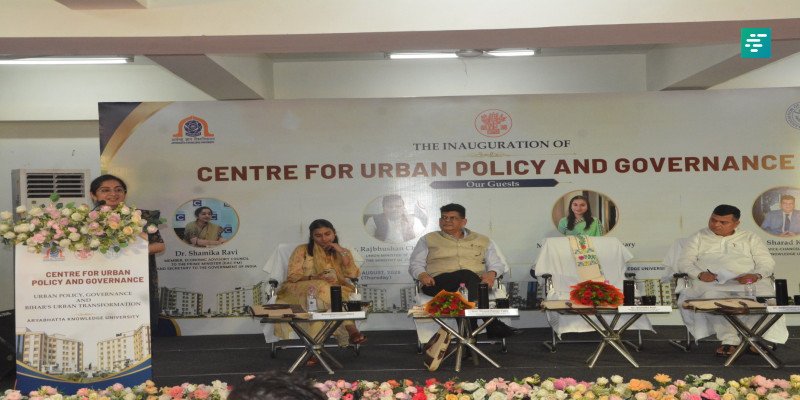
Aryabhatta Knowledge University, Patna, formally inaugurated Bihar’s first Centre for Urban Policy and Governance. The centre was inaugurated by Dr. Shamika Ravi, Member of the Economic Advisory Council to the Prime Minister. The inauguration ceremony was attended by Union Minister of State for Jal Shakti, Government of India, Dr. Raj Bhushan Choudhary; Member of Parliament Shambhavi Choudhary; Vice-Chancellor Prof. (Dr.) Sharad Kumar Yadav; along with university officials, faculty members, researchers and a large number of students.
The establishment of the Centre marks an important step towards promoting evidence-based research on the rapidly changing urban landscape of Bihar and developing practical solutions to emerging urban challenges.
Addressing the inaugural ceremony, Dr. Shamika Ravi particularly appreciated the initiative, vision and leadership of Aryabhatt Knowledge University Vice-Chancellor Prof. Sharad Kumar Yadav. She said that establishing a centre dedicated to contemporary issues of urban policy and governance is the need of the hour. As India is rapidly urbanising, the role of universities cannot remain confined to classrooms and academic curricula. Higher educational institutions must undertake research on real-world challenges confronting society and governments and strengthen policy dialogue to develop practical solutions. She expressed hope that the centre would promote high-quality research on critical urban development issues and serve as an effective platform for dialogue between policymakers and academia.
Vice-Chancellor Prof. (Dr.) Sharad Kumar Yadav said that the Centre for Urban Policy and Governance is not merely the establishment of a new academic centre but an institution dedicated to research, dialogue and policy discourse on the changing needs of urban India. He noted that cities in Bihar are undergoing rapid transformation. While urbanisation is creating opportunities for economic activity, employment and development, it is also generating challenges related to housing, transportation, water supply, sanitation, the environment, public health and infrastructure.
Prof. Yadav emphasised that these challenges can only be addressed by taking into account local conditions, available data and the actual needs of citizens. He said that understanding urban problems requires a multidisciplinary approach rather than the perspective of a single discipline. Economics, sociology, environmental studies, engineering, public administration, public policy and data science must come together to generate meaningful solutions. The centre aims to institutionalise this integrated approach and create an effective bridge between research, policy and practical governance.
He further said that the university would provide students and researchers with opportunities to work directly on real urban challenges and engage with urban local bodies and communities. This would enable them to gain practical exposure to urban governance while developing research and policy-analysis skills.
Union Minister of State for Jal Shakti, Dr. Raj Bhushan Choudhary, said that better infrastructure and effective administration are essential in an era of rapidly increasing urbanisation. He emphasised the need for strong systems for sanitation, drinking water, transportation, environmental protection and civic services, along with urban administration that is more accountable, capable and citizen-centric. Appreciating the initiative of the Vice-Chancellor, he said that the centre could make a significant contribution to the field of urban policy and administration in Bihar. He also highlighted the importance of stronger coordination among governments, universities, research institutions and urban local bodies.
MP Shambhavi Choudhary said that urban development cannot be limited merely to roads, buildings and physical infrastructure. Transparent governance, citizen participation, environmental protection, social inclusion and equal opportunities are equally important for building better cities. She noted that transportation, sanitation, green spaces and public amenities have a direct impact on the quality of life of citizens. She described the new centre as an important opportunity for students and researchers to explore emerging areas of urban development and governance.
The centre plans to promote collaboration among government departments, urban local bodies, development agencies, universities, research institutions and experts. Its activities are expected to include expert lectures, policy dialogues, research projects, workshops, field studies, interdisciplinary research and practical training. These initiatives will aim to familiarise students and researchers with ground-level urban challenges while providing them with practical exposure to research, governance and policy analysis.
The programme also witnessed discussions on urban development, good governance, local governance, citizen participation and emerging challenges facing cities in the future. Speakers emphasised that evidence-based policymaking, capable local institutions and active citizen participation are essential for achieving sustainable and inclusive urban development in Bihar. Faculty members, students and researchers from various schools of the university, along with academics and researchers from other institutions based in Patna, actively participated in the programme.
Prof. Sharad Kumar Yadav expressed confidence that, in the coming years, the centre would emerge as an important hub for research, training and policy dialogue in the fields of urban policy, governance and development. He said that the university’s objective is to connect knowledge with the real needs of society and governance. In Bihar’s rapidly changing urban landscape, he emphasised, building knowledge based on local experiences and evidence will be fundamental to creating better policies and, ultimately, better cities.
